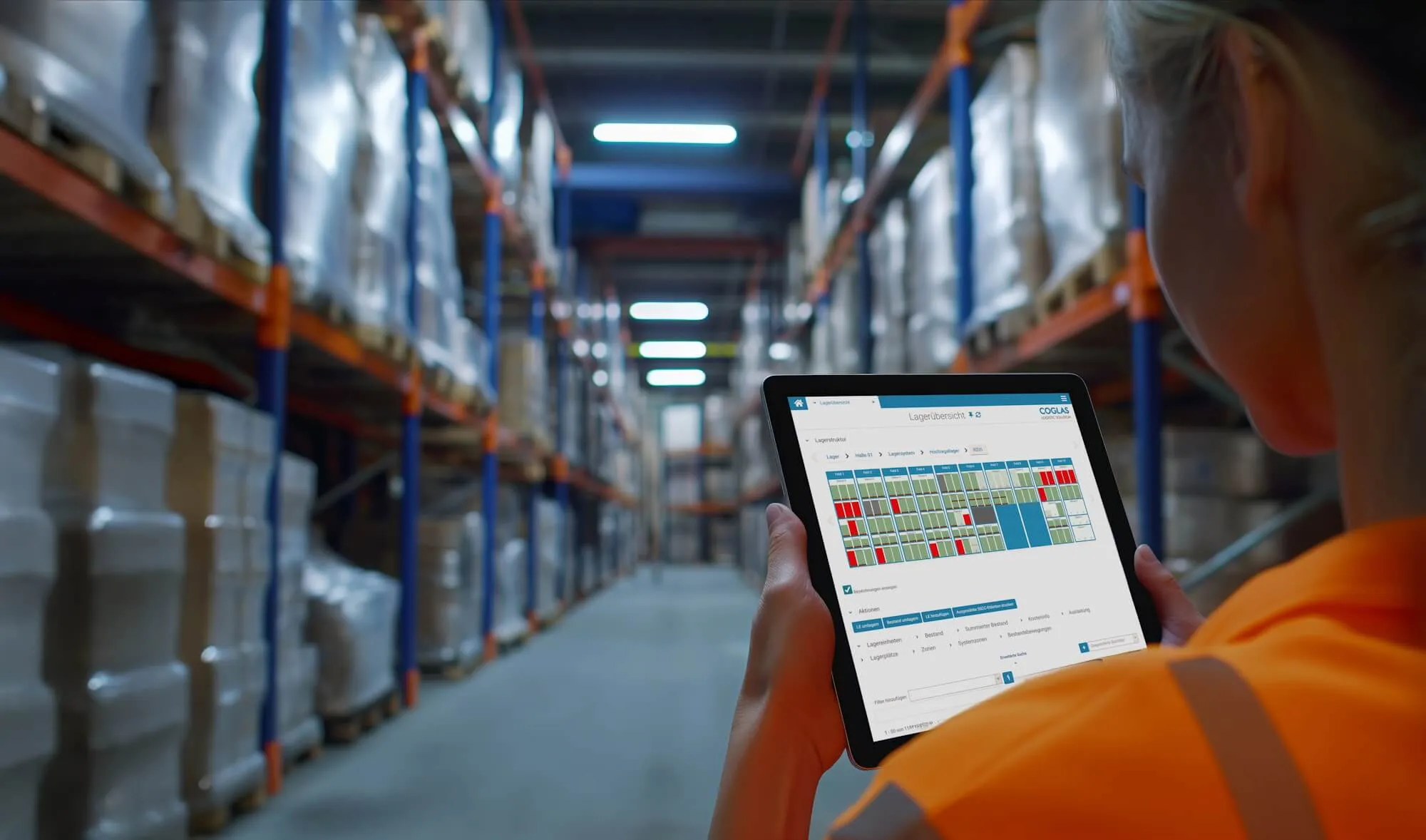
Goods receipt with best-before date and batch
Capture best-before date, batch, QA and block status on receipt.
Industry food and beverage
Food and beverage warehouses need more than quantities and locations. Best-before dates, batches, blocks, traceability and clean picking rules must be visible in the process. COGLAS WEB WMS brings these requirements into one continuous flow: multi-client and multi-warehouse capability, integrations to ERPs such as SAP, shops and carriers, web-based and usable directly in the browser.
Reply typically within one business day.
In brief
A warehouse management system (WMS) for food and beverage warehouses must reliably control stock levels, batches, best-before dates, blocked stock, FEFO/FIFO rules, goods receipt, picking, shipping and traceability. COGLAS WEB WMS supports food and beverage warehouse processes with transparent batch and best-before management, block and QA status as well as integrations to ERPs such as SAP, proALPHA, shops and carriers. Entry starts from €490/month; with a suitable starter scope, go-live is possible within a few days.
Matching reference
Wie ein Logistikdienstleister Fulfillment, Industriekunden und Schnittstellen auf einer WMS-Plattform abbildet.
Logistikdienstleister · Fulfillment · Multi-Mandant View reference„Vom Fulfillment bis hin zur Anbindung großer Industriekunden können wir alle notwendigen Schnittstellen nahtlos integrieren.“ (Original quote in German)
Industry FAQ
Yes. COGLAS WEB WMS can take best-before dates, batches, block status and movements at goods receipt, stock, picking and shipping into account. Via integrations to ERPs such as SAP, proALPHA, shops and carriers, batch and status data can be exchanged end to end.
FEFO stands for First-Expiry-First-Out. Goods with an earlier expiry date are moved with priority, provided customer and quality rules allow it. In COGLAS WEB WMS, best-before and batch management as well as outbound moves following FEFO or minimum remaining shelf life are configurable as a rule.
Yes. COGLAS WEB WMS maps batch and status-related processes end to end: from goods receipt through stock and picking to shipping and tracking number back to ERP or shop. Which traceability data is actually needed is clarified in the COGLAS fit-check.
COGLAS WEB WMS runs batch, best-before date, movements, block status and shipping reference close to the process, so affected stock can be found faster during a recall. Which recall and audit data is needed is defined together before go-live. Für Lagerleitung, IT und Operations ist das relevant, wenn das Thema operative Lagerprozesse, Systeme und Verantwortlichkeiten im Tagesgeschäft beeinflusst.
FIFO moves the oldest received goods first. FEFO prioritizes goods with the earliest expiry date. For food and beverage warehouses, FEFO is more important in many processes because minimum shelf life and minimum remaining shelf life directly drive picking, blocks, customer requirements and complaint risk.
Still open questions? Talk to our team →
Next step
The demo focuses on your industry, your warehouse processes and a sensible starting scope: which tasks should go live first, which integrations matter and where standard processes are enough.