
Rule-based triggering of replenishment for picking, buffer and staging locations.
Material flow control in the web-based WMS
Material flow control in the warehouse
When internal transports stay opaque, forklifts run empty and replenishment is organized manually, the warehouse loses pace. COGLAS WEB WMS coordinates material flow, drive orders and replenishment systematically and couples internal transports directly to goods receipt, picking and shipping.
COGLAS WEB WMS Connects to your system Standard processes at go-live
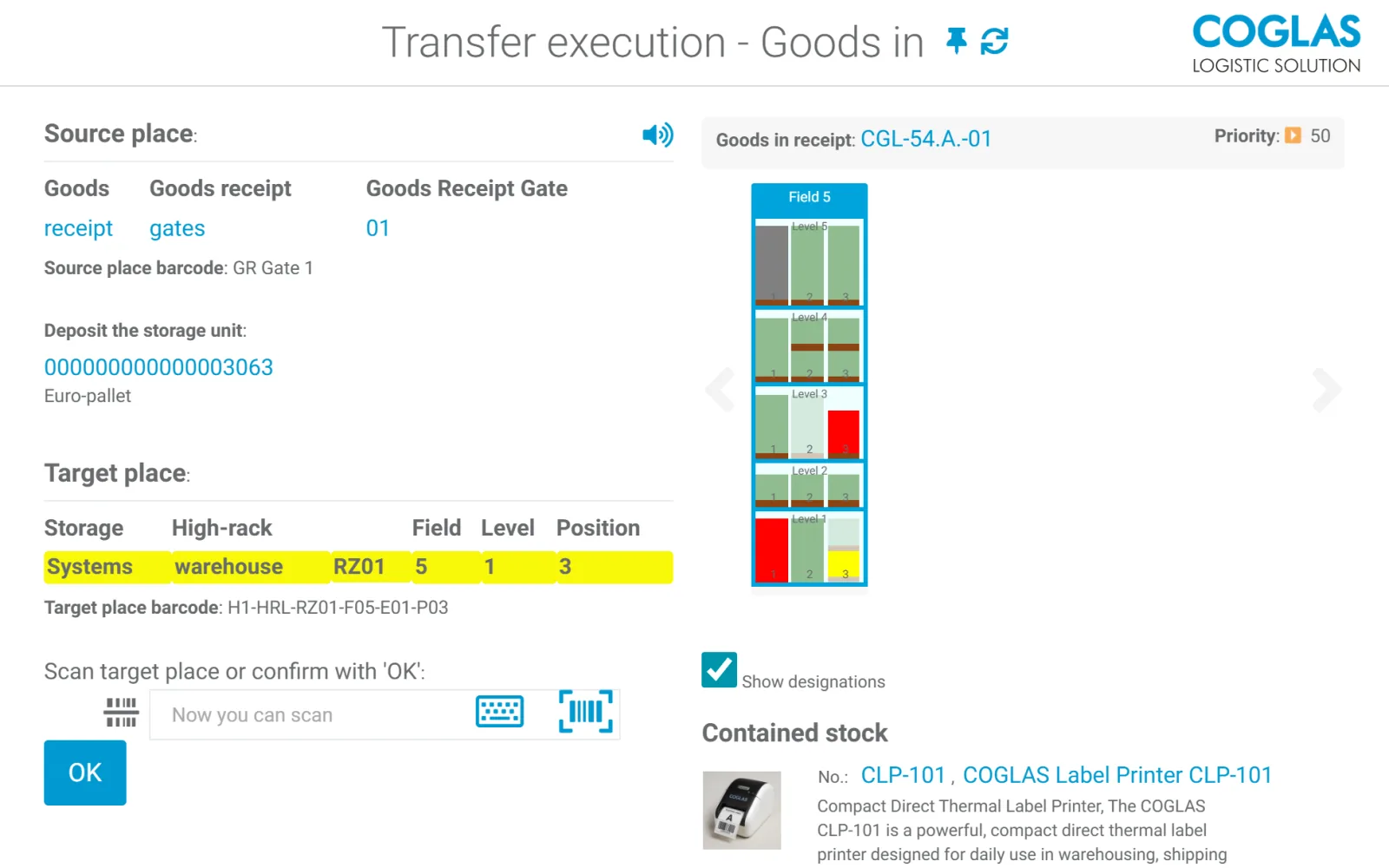
Process logic
material flow control: connect status, data and next steps
Material flow control is the planning, triggering and monitoring of all internal goods movements in the warehouse, such as replenishment, relocations, forklift runs, staging and transports between process stations. A WCS, warehouse control system, controls or coordinates automated warehouse technology such as conveyor systems, vertical lift modules or other facilities. COGLAS WEB WMS combines stock, storage locations, orders and transport tasks, generates and dispatches drive orders through a forklift control system, organizes replenishment automatically and integrates facilities and conveyor systems via WCS or fleet controller. Routes become transparent, empty runs decrease and material flow stays coupled to the core processes.
Generate, prioritize, bundle and route-optimize drive orders for forklifts and staff.
Movement data from conveyor, rack and facility hardware is consolidated centrally; critical situations such as blocked segments become visible and manageable.
Manage and document relocations, consolidations and stock compaction systematically.
Operational signals
Where internal material flow gets stuck today
COGLAS WEB WMS surfaces disruptions, status and open steps early so warehouse teams don't have to fix things after the fact.
01
Empty runs and inefficient routes
Forklifts operate unbundled and without route optimization. Empty runs cost time, energy and capacity.
02
Missing replenishment control
Picking and buffer locations run empty because replenishment is not triggered systematically and on time.
03
Opaque internal transports
Who moves what, where and in which status? Without a system, there is no overview of ongoing movements.
04
Manual drive orders
Transport orders are handed out by shouting, notes or gut feeling instead of rule-based and prioritized.
05
Bottlenecks at handover points
Orders pile up at goods receipt, packing and shipping zones because handovers are not coordinated and timed.
06
Missing coupling to warehouse processes
Material flow runs in isolation alongside goods receipt, picking and shipping instead of being cleanly interlinked.
Guided flow
The building blocks of material flow control
Every step produces useful data for inventory, status, follow-on processes and leading systems.
- 01
Replenishment control
Rule-based triggering of replenishment for picking, buffer and staging locations.
- 02
Drive order management
Generate, prioritize, bundle and route-optimize drive orders for forklifts and staff.
- 03
Connecting material flow controllers
Movement data from conveyor, rack and facility hardware is consolidated centrally; critical situations such as blocked segments become visible and manageable.
- 04
Internal relocations
Manage and document relocations, consolidations and stock compaction systematically.
- 05
Conveyor and facility integration
Integrate conveyor systems and facilities into the material flow via WCS or fleet controller.
- 06
Coupling to core processes
Interlink material flow with goods receipt, picking and shipping so transports are triggered by the process.
Material flow control with COGLAS fits when
- internal transports should be managed transparently and not just by shouting.
- replenishment for picking and buffer locations should be triggered automatically.
- forklifts and staff should receive drive orders through a forklift control system.
- conveyor systems or facilities should be connected via WCS or fleet controller.
- material flow should be tightly interlinked with goods receipt, picking and shipping.
Material flow control with COGLAS does not fit when
- the warehouse has no internal transports or replenishment processes.
- only fully automated facility control without a WMS link is required.
- neither drive orders, replenishment nor coupling to warehouse processes are needed.
FAQ
Frequently asked questions
What is material flow control?
Material flow control is the planning, triggering and monitoring of all internal goods movements in the warehouse. This includes replenishment, internal relocations and transports between process stations. The goal is a transparent, efficient material flow that is tightly coupled to goods receipt, picking and shipping.
What does WCS mean?
WCS stands for warehouse control system. A WCS controls technical facilities and material flow components such as conveyor systems, vertical lift modules or automated transport equipment. A WMS runs warehouse processes at order, stock and storage location level; in practice, WMS, WCS and material flow control must work together cleanly.
What does a forklift control system do?
A forklift control system generates drive orders and dispatches them rule-based to forklifts and staff. It prioritizes and bundles transport orders, optimizes routes and thus reduces empty runs. In COGLAS WEB WMS, the forklift control system is part of material flow control and coupled to warehouse processes.
How does material flow control reduce empty runs?
By capturing, prioritizing and bundling transport orders centrally, outbound and return trips can be combined and routes optimized. Drive orders reach the nearest suitable forklift. Empty runs decrease and the available transport capacity is used more effectively. Für Lagerleitung, IT und Operations ist das relevant, wenn das Thema operative Lagerprozesse, Systeme und Verantwortlichkeiten im Tagesgeschäft beeinflusst.
Can COGLAS be connected to conveyor and warehouse technology?
Yes. COGLAS WEB WMS can be connected to forklifts, conveyor systems, facility hardware, paternosters and vertical lift modules via web API and JSON, CSV or XML as well as via WCS or fleet controller. The specific integration is clarified in the quick check.
What is the material flow controller (MFR)?
A material flow controller is a central control module that consolidates movement data from conveyor, rack and facility hardware, detects critical situations such as blocked segments and sends control commands back. In COGLAS WEB WMS, the material flow is visualized in real time, with congestion zones, loops and handover points where staff can intervene with a click.
Which warehouses benefit from material flow control?
Material flow control pays off particularly where many internal transports, replenishment processes or handover points come together. Even small teams starting from 1 user benefit from transparency and fewer empty runs; as warehouse complexity grows, the benefit increases. Für Lagerleitung, IT und Operations ist das relevant, wenn das Thema operative Lagerprozesse, Systeme und Verantwortlichkeiten im Tagesgeschäft beeinflusst.
Still open questions? Talk to our team →
Product tour
See this process in the product tour
Jump straight to the matching COGLAS view for Material flow control. You will see the screenshot, hotspots and the key process highlights without a form barrier.
Warehouse and logistics teams rely on COGLAS WEB WMS












Next step
See live whether COGLAS fits material flow control
The demo focuses on process scope, system landscape, data quality and integrations. That quickly makes clear which starting scope makes sense.